Showing posts with label rehabilitation. Show all posts

Monday, June 27, 2016

Borders of Torture: Solidarity Vigil on UN International Day in Support of Victims of Torture


Report
As we have done every year since 2010, the London Guantánamo Campaign marked UN International Day in Support of Victims of Torture, 26 June, with a public vigil in solidarity with all victims and survivors of torture worldwide. With the international theme this year of “Support Life after Torture”, the LGC turned its attention to one of the biggest crises currently facing the world: the refugee crisis. There are currently over 65 million people worldwide displaced by wars and conflicts and over half of them are children. Many of the people seeking refuge abroad are survivors of torture. As well as a difficult journey to safety, which can include further persecution and inhumane treatment, many men, women and children are denied refuge or are treated like criminals and held in appalling conditions in immigration detention centres and denied access to rehabilitation and adequate care.


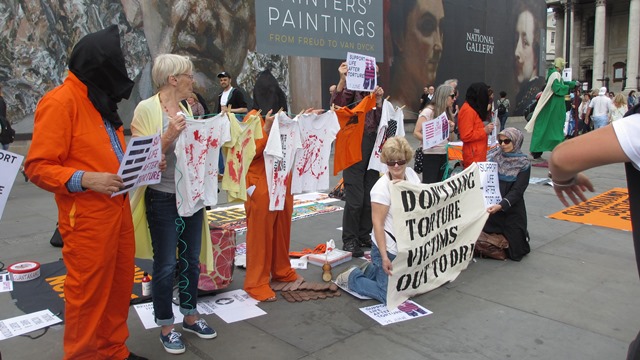
The LGC highlighted the poor response from the UK and other European states in a silent vigil attended by around 20 people. Our solidarity action was very visual and powerful. The vigil, entitled the “Borders of Torture” involved activists holding up a washing line with bloodied (no one was harmed in the process) t-shirts and an accompanying banner stating “Don’t Hang Torture Victims out to Dry”. On a sunny and crowded afternoon in central London’s Trafalgar Square, the action was a huge hit with the public. Many people stopped to contemplate the message, take photographs of it, take leaflets and talk to activists handing them out. Overall, the public response was very positive and supportive of the action. The LGC was joined by the Guantánamo Justice Campaign and individuals activists on issues such as covert harassment. The LGC thanks everyone who joined. 
This year’s theme and action are not a departure from our regular work on Guantánamo Bay prisoners as more than half of the remaining 79 prisoners are in the exact same position as the refugees fleeing their homelands. Many cannot return to their countries of origin due to wars there and do not have a safe third country to which they can be sent. Yemenis make up the largest nationality group at Guantánamo. Almost 30 are cleared for release but remain at Guantánamo as they have nowhere to go. Some have been cleared for release for over a decade. As well as offering refuge, states must also ensure that torture survivors have a right to redress and rehabilitation.
Although we take the opportunity to give a voice to the voiceless on 26 June each year, the LGC stands in solidarity with torture victims and survivors every day of the year. Our London vigil was one of dozens held worldwide by different organisations and coordinated by the International Rehabilitation Council for Torture Victims.

Friday, June 03, 2016

The Borders of Torture: 26 June Solidarity Vigil


The London Guantánamo Campaign invites you to join us at

The Borders of Torture 

26 June Solidarity Vigil for International Day in Support of Victims of Torture

On: Sunday 26 June 2016
At: 2-4pm
outside the National Gallery, Trafalgar Square

The world is currently in the grip of a refugee crisis. Though many European states have contributed to creating the very contexts refugees are fleeing, they continue to ignore the plight of desperate individuals and families who seek refuge in their midst. Of those seeking refuge in Europe, a large proportion are survivors of torture in their home countries [1]. In addition, the journey to safety is often tortuous and can involve different forms of torture, violence and inhumane treatment. Large numbers are now being turned away at the borders of Europe and sent back to war and persecution at home. For many who enter, conditions in immigration detention centres [2] are often tantamount to inhumane and degrading treatment. 
 
26 June each year marks UN international day in support of victims of torture. We invite you to join us in solidarity with victims of torture worldwide and to call on governments to do more to support them. This includes ending the violence of our borders, and providing refuge where necessary. It also requires ensuring refugees are given adequate access to rehabilitation facilities wherever they are to help heal some of the physical and mental scars resulting from the various forms of torture to which they have been subjected.

Why is the London Guantánamo Campaign organising this event?
Since 2010, the London Guantánamo Campaign has marked this date with a public vigil in solidarity with ALL victims and survivors of torture worldwide. A large number of the remaining prisoners at Guantánamo are in a similar situation to the refugees arriving at Europe’s borders. All are survivors of or are currently subject to torture, and many cannot return home due to war and unrest, lacking a safe third country to which they can be sent. The largest group affected by this situation are the 20+ Yemenis cleared for release but who cannot be sent home. Several of the Yemenis recently accepted by third countries had been free to leave for over 10 years but had nowhere safe to go. 

The London Guantánamo Campaign believes that all torture victims have a right to redress and rehabilitation and must be given adequate means to obtain these.

For more details: e-mail london.gtmo@gmail.com or call Aisha on 07809 757 176

Friday, October 30, 2015

Media release: London Guantánamo Campaign welcomes release of last British resident in Guantánamo Bay


For immediate release: Friday 30 October 2015

The London Guantánamo Campaign [1] welcomes the release of the last British resident held at Guantánamo Bay, 48-year old Saudi national Shaker Aamer [2]. Mr Aamer, who has indefinite leave to remain in the UK and a British family, has been held in Guantánamo Bay since February 2002 where he has never faced charges or trial, and was first cleared for release in 2007.   

Aisha Maniar, spokesperson for the London Guantánamo Campaign, says, “The London Guantánamo Campaign welcomes the release of the last British resident Shaker Aamer, for whom we have campaigned since 2006.

“We are pleased for the family of Shaker Aamer and hope they will be given the space and privacy to reunite and reconnect as a family. Release from indefinite detention and torture after almost 14 years creates new challenges and difficulties and we urge that Shaker Aamer is given adequate opportunity to receive rehabilitation and all the care he requires as a survivor of torture.

“Shaker’s case has nonetheless demonstrated the frailty of the ‘special relationship’ between the US and UK. Unanswered questions remain, particularly why it has taken so long, when he was first cleared for release and his return was sought in 2007. Both the Conservative and Labour parties must respond.

“There are still 112 prisoners held at Guantánamo Bay and we will continue to campaign for their release and the closure of the prison camp. The London Guantánamo Campaign also thanks the many individuals and grassroots organisations who have worked tirelessly for many years for his release, long before his case came to the public attention.”
ENDS

NOTES TO EDITORS
1. The London Guantánamo Campaign was set up in 2006 and campaigns for justice for all prisoners at Guantánamo Bay, for the closure of this and other secret prisons, and an end to the practice of extraordinary rendition. http://londonguantanamocampaign.blogspot.com     

2. For more details on Shaker Aamer’s case, see http://www.reprieve.org.uk/case-study/shaker-aamer/

Sunday, June 28, 2015

26 June: Torture Victims Have a Right to Rehabilitation


Solidarity Vigil


As we have done every year since 2010, the London Guantánamo Campaign held a vigil in solidarity with victims and survivors of torture everywhere on Friday 26 June to mark UN International Day in Support of Victims of Torture. The silent vigil, held in Trafalgar Square on a busy Friday evening was attended by around 40 people and supported by the Save Shaker Aamer Campaign.


Noel Hamel (centre) with the banner he made for this event)


One of dozens of events held worldwide to mark this important date, the theme this year is the right to rehabilitation. This involves a number of factors to help restore survivors to the situation they were in – physically, mentally, psychologically, materially – prior to being tortured as best as is possible. It covers a variety of means such as compensation, physical rehabilitation, therapy, justice and guarantees it will not happen again. Although a human right, many victims do not receive any such treatment or facilities.

The right to rehabilitation was highlighted at the vigil with placards, leaflets handed out with information on the issue and banners mentioning the relevant UN articles on rehabilitation for torture victims. Although usually very well received and supported by the general public, increasing misinformation and propaganda in the mainstream media over various issues has left quite a few people confused about what torture is and who torture victims are.

Right to Rehabilitation and Guantánamo Prisoners*
The right to rehabilitation is a major issue for both former and the remaining 112 Guantánamo prisoners. All are survivors of torture both at the prison camp and in other US military and CIA-run facilities. The release at the end of 2014 of a redacted version of the US Senate report into CIA torture under the so-called War on Terror has shed further light on the abuses and inhumane practices prisoners – the vast majority of whom have never been charged or tried – have been subjected to.

Earlier this month, gruesome details were published of the torture faced by Majid Khan who after being kidnapped in Pakistan in 2003 was held at secret CIA torture prisons between 2003 and 2006 until being taken to Guantánamo Bay. Earlier this year, lawyers for one of the defendants facing trial for alleged involvement in the September 11 2001 attacks revealed details of the torture their client suffered through CIA torture and from which he still suffers due to inadequate medical care, including the inability to sit down comfortably due to rape.
 
Few prisoners have ever received adequate medical care at Guantánamo Bay. It was only in 2014 that Omar Khadr, held at Guantánamo Bay for over a decade, and released to his native Canada in 2012 finally received treatment for a shoulder injury he sustained in 2002. A former Russian prisoner, released in 2004, still has a bullet lodged in his thigh from an injury in an Afghan prison in 2001 due to inadequate care at Guantánamo and in Russia. 

In addition, the response to prisoners protesting their indefinite detention through hunger strikes has been met with more torture through force-feeding. The long-term effects of such action on the body are not dealt with and can lead to further health complications later on. The US must provide the prisoners it is currently holding with adequate medical care and also expedite periodic reviews of prisoners held without charge or trial, deemed “forever prisoners”, as a means of rehabilitation.

For prisoners who are released, rehabilitation can remain a challenge. With the current drive to empty Guantánamo by the Obama administration, over the past year, many of those released have been sent to third countries due to insecurity and war in their own countries of origin. As the US washes its hands of prisoners as soon as they are released, some can find themselves facing almost-complete isolation and poverty in their new surroundings. In May 2015, a former prisoner released to Kazakhstan at the end of 2014 died of kidney failure due to inadequate medical care at Guantánamo and after his release. 
 
While the US is applauded for prisoner releases, not much emphasis is put on the often precarious situations former prisoners find themselves in post-release. The US must ensure that all prisoners are released to countries where they are safe and their physical and moral integrity is not compromised. They must be guaranteed the right to rehabilitation, including legal, medical and financial assistance.
 
The London Guantánamo Campaign remains committed to ensuring justice for all Guantánamo prisoners. While we emphasised how this issue affects Guantánamo prisoners, it relates closely as well to all prisoners who have been and are the subject of extraordinary rendition, an ongoing programme by the CIA.

Media of the event:

* These issues were raised at a meeting held in the UK parliament on Tuesday 23 June 2015 on the case of British resident and Guantánamo prisoner Shaker Aamer by Aisha Maniar, organiser of the London Guantánamo Campaign